
Home › Forums › Bass Cat Boats › Charger Problems
 Sparker.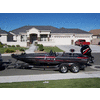
Have A 4bank charger on my 2010 Puma FTD 2 of the banks have gone bad ( as they say %^!~ happens) dealer just called and said Basscat was overnighting charger (GREAT) EXCEPT, they are sending a 3bank and a 1bank to replace my 4 bank, he said this is what Basscat is doing now on all 4bank systems! Now Im going to have 2 plug ins to plug in. Anyone with a new 2011 confirm this? Personnally I think it”s a Joke to spend close to 60 grand on a boat have this kind of a system. Im not happy about this at all!!!

I dont have that exact charger but did you try unhooking that battery from the charger, waiting a few seconds and hooking it back up? The guest I have, that seems to correct anything funny that might be going on.

No i didnt try that yet. As soon as it stops raining Ill give that a try. Couldnt hurt…..thanks
That has been one of the most reliable chargers we have used. The only reason BCB left Guest was the availability at that time. You can still get a replacement as far as we know and after 9 years of use it might be necessary. The other thing to check are the end fuses on the battery leads.
BCB went that direction as a result of the four (4) bank failure rate. They are trying to lower problems and you should get a Q Tab (splitter) with the set up for the plug in. Though now when you want to maintain the cranking battery on storage it can be done with the one (1) 12 volt charger. Reducing problems is the goal here and improving systems. We hope this answers your questions. BCB

Yes my 2011 has a 3 bank charger and a 1 bank charger. The 3 bank is a Noco and the 1 bank is a Pro Sport.
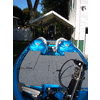
Is that the way all the 2011 4bank charging needs will be? Is there one or two plugs for power?

Building power electronics can be tricky business.If the product was designed correctly (thermal management, load margins, etc) we find premature field failures are due to ESD damage.An electrostatic charge will build up in the body. If not drained off properly, the human body will discard thousands of volts into a semiconductor device. A ‘snap’ is about 5,000 volts.Under a microscope the pn junction looks like it has bomb craters in it.This weakens the device because a good chuck of the junction is blown away.Less material is in place to handle current flow.Certain materials will hold a charge like Kraft (brown) boxes and polyester clothing.Special conductive tote boxes must be used to protect pc boards when they go from one department to another.The entire plant must be protected and grounded properly. Benches, assembly equipment, etc.Our floor has a special dissipative coating that must be stripped and reapplied every year.Some places use expensive tile from 3M that does the same job.The operators where special heel straps that discard any charge the body creates when moving.Once the circuit board is encased, MOV’s or other surge absorber devices are used protect the inputs.Not saying that is the problem here but I recommend BCB ask any electronic supplier for a ESD plan.

BCB always has a reason for a change, and most of them are especially for our benefit. They explained the situation, and it sounds like a more than practical solution. BCB has never recommended an on board charging system, and installs them only because we want them for simplicity. They still recommend a Lester carry charger for most applications.

I think something like this would work. I dont think the chargers pull that many 120V amps so it should not be a problem.http://www.amazon.com/s/?…p;ref=pd_sl_41oypcoglb_bBest of both worlds is an on-board and a Lester or equivalent. The Cul-M-Rite three-bank I have charges pretty slowly, and there are times I want my batteries charged up sooner. So I have a pretty cheap 12V fast charger with an AGM switch that works pretty well. Maybe I need two more and a three-way splitter….Steve
© 2026 Bass Cat Boats
