
Home › Forums › Bass Cat Boats › Which Big Cat is Calling Your Name?
 RickH.
Which Big Cat is Calling Your Name? Written and provided by Peter Robbins Like any consumer product, bass boats go through trends, some of them good, some of them better left to the scrap heap of history. With some developments, the jury is still out – they may prove to be necessary for some anglers and not as useful for others. As you head into boat show season ready to make a purchase, it’s important to understand not only where the industry is heading, but also where it has been – and when you write that check, you want to get the boat that’s right for you, not the one that’s right for anyone or everyone else. Right now, the characteristic that many manufacturers seem to be pushing most vehemently is wide decks. As far as some consumers are concerned, the wider the better. Of course, a little bit of thought shows that there is a logical end to the benefits of width. Eventually a widening deck will hamper performance on the outboard as well as on the trolling motor. Still, conventional wisdom seems to hold that as long as you can maintain some semblance of performance, a wider deck has more plusses than minuses. Again, for some anglers that may be true, but for others it’s clearly false. Just as different people need different vehicles, different houses and different spouses, there’s no such thing as a one-size-fits-all bass boat. Despite having a variety of deck widths to choose from, Bass Cat pros Kevin Short and John Crews both prefer the Eyra for their tour-level fishing. It’s not quite as wide as the Puma or Cougar, which in turn does not have the breadth of the Caracal or Jaguar. So with wider options to choose from, why is the Eyra their boat of choice? “It does everything I want it to do,” Short said. “It rides well in rough water. It’s dry. It’s easier to maneuver, easy to get around, and has scads of storage. For what I do, it’s the perfect hull and deck.” He’s fished out of all of the BCB platforms, and rather than judging them solely by the width of their decks, he also divides them in terms of the length of their decks: “The way I see it, the Jag and the Caracal are wide deck boats. The Puma and Cougar are long deck boats. The Eyra is kind of in between. There are advantages to all three designs.” So what’s the advantage of having a narrower platform at the very front? “One thing I don’t like about wider boats is that you have to stand on the side of the boat to flip or make roll casts,” Short answered. “With a narrower front deck you can get closer to your target and you don’t have to worry about bouncing your 20 dollar wood crankbait off the gunnel.” Put another way, you can stand in one spot at the trolling motor pedal and flip or fish a topwater or stickbait in a range of over 180 degrees without changing your footing. Twenty Foot Choices Crews, who went from a different brand’s wide deck boat to the Cougar/Puma layout, and then to an Eyra, agreed that despite his personal needs different anglers will feel comfortable in different layouts. “If you’re coming from another wide-bodied boat brand, the Cougar or Puma is a good transition,” he explained. “It’s a big jump to the Eyra. The way I explain it to a lot of people is ‘Do you want to drive a sports car or do you want to drive an SUV?’ If you don’t care about speed and you just want comfort, your choice may be different than if you’re someone who likes to mash the gas pedal once in a while.” Beyond anglers coming from other brands, who will benefit from the wider deck models? One group who might like them is those who fish team tournaments, with both anglers on the front deck at all times. That’s certainly doable in an Eyra, but the Cougar and Puma might lend themselves to it a little bit better. Additionally, if you’re someone who uses a butt seat on a regular basis, “the Eyra is probably not your boat,” Crews said. “I don’t fish with a pole or seat in the front much. If you run and gun and rarely use the seat, once you make the transition, you’ll really prefer the narrower front, but if you fish with a seat or you like to have eight or more rods on the deck, that wider deck is nice to have.” One other advantage of the narrow deck is its maneuverability in tight places, like standing timber, where it will often sneak through gaps that hang up the wide-bodied “aircraft carriers.” Despite the preferences of Crews and Short, some BCB pros remain steadfastly loyal to the Puma/Cougar platform. As Britt Myers said. “I’ve run them for the past five years. I don’t know anything that I would change. I believe that if it’s not broke, you don’t fix it.” Arkansas pro Billy McCaghren agrees. “It’s not quite as sporty of a ride [as the Eyra],” he said. “But it’s just as fast and it’s a deck layout that I’ve become accustomed to.” Not Just Deck Size – Layout, Too With the introduction of the Eyra, Bass Cat had taken what was a relatively minor difference in deck layouts between the Puma and Cougar and added an altogether different option – the side-by-side “coffin” lids in the middle. “I prefer them,” Short said. “You can sit on one side and get into your tackle on the other side, but for some guys the other decks may be better. On the Cougar, for example, you have one big compartment and one medium-sized compartment, so you can have all of your tackle in one place to get what you’re looking for. I get that. There’s no perfect layout for everyone. Some guys love all of the separate compartments of the Puma. Other guys love the simplicity of the Cougar. And some guys hate the coffin lids that I like” McCaghren is one who prefers the “two good sized boxes” of the Cougar platform. “I’m not as neat as a lot of people. I’m not a slob, but I just kind of throw my stuff in however it fits and the Cougar makes that easy.” “Part of the secret to any boat Is how do you best utilize the storage,” Crews added. “In some brands, that’s already figured out for you – you put these boxes in these slots. I prefer my stuff changed or tweaked a little bit each year.” All three 20-footers hold more tackle than any angler will ever need. Still, as Crews hinted, gear placement matters not just for organizational efficiency but also for boat performance. For example, Crews likes to keep the nose of his Eyra relatively light, and puts heavier items like jigs and weights behind the driver’s seat. “I want as much of the weight in the back as possible,” he said. Short said that it’s equally important to load the Puma and Cougar light up front. “There’s so much storage in the front, that it’s easy to put too much weight up there. The hole shot will suffer because it’s trying to pick all of that weight up. A hundred pounds up there versus 20 pounds is a whole different world.” Myers disagreed somewhat, stating that “I’ve loaded this boat every way you can imagine and nothing makes a difference in its ride.” The truth is probably somewhere in between – within the scope of reasonableness, there are a lot of different ways to pack your gear, and only in extreme cases of excess weight is the impact of the distribution noticeable. More Performance Considerations All of Bass Cat’s 20-footers set an industry standard for rough water ride, and any of them would likely be among the fastest hull on tour, too. In fact, Crews said that if his co-anglers or Marshals comment on the ride of the boat at the end of the day, it never has to do with the width of the deck or the benefits of the storage layout, but rather on its speed. “Eight out of 10 times, their comment is ‘Holy cow! This boat is fast,’” he said. The superlative rough water ride tends to come into focus only when other riders start to complain about the rides of other brands. “At the last day we fished at Bay de Noc it was pretty rough,” Crews said. “When we got back in, guys were talking about how bad their backs hurt. Those were guys in 21 foot boat and I was in a 20’2” boat. My partner just looked at me and said ‘It wasn’t that bad at all.’ If I had a choice of any boat to run on the Great Lakes, I’d still choose the Eyra. You have more control than any other boat when you’re going up and down those 6 and 8 foot waves. It handles turns real well and it’s a soft ride.” In order to get the best mix of speed, handling and rough water ride, it’s still necessary to set the boat up right. Increasingly, these are “point and go” models, but when pushed, it’s critical to know what they are and are not capable of accomplishing. Crews, Short and Myers run hydraulic jackplates on every boat they purchase. “All of them will benefit from it,” Short said. “But the Eyra is the only one that absolutely has to have it from a performance perspective. What I really use it for is idling long distances in shallow water. And in really big water, with a fixed plate it’s never really low enough.” McCaghren is one of the minority of tour-level pros who runs only a manual jackplate. He said that while his Cougar might benefit slightly from a hydraulic model, the downsides outweigh the positives. “It means I have less that can go wrong,” he said. “I had one tear up on me 50 miles from the weigh-in. It was a tournament that I would’ve won and I didn’t make it back. When it comes to props, Short believes that the Mercury Fury is the best option for the vast majority of circumstances. “It used to be that everyone ran a Trophy,” he said. “But a 25 or 26 Fury is the best all-around for most situations.” McCaghren prefers the 25 in the summertime, when his boat is loaded especially heavy, or if he’s running the big water of the Great Lakes, but when it’s cool he’ll often switch to the 26. Myers purposely keeps his boat light, with lithium batteries and other weight-saving tricks, but he still notes that anglers need not take those same steps to get both speed and rough water ride that’s better than the competition. “My boat is not exceptionally sensitive to weight,” he admitted. “it doesn’t take a rocket scientist to get the performance optimized.” Don’t Overlook the 19 Footers It’s easy to get caught up in 20 foot fever, thinking that you have to run what the pros do. Even if you aspire to a pro career, fishing regional and even AAA-level events, BCB offers legitimate 19 foot options that are worth considering. They’re often easier on the pocketbook out the door, on the road and on the water, too. “I choose not to run one because of the bodies of water we fish,” Crews said. “We go to the Great Lakes and places like Rayburn, Toledo Bend, and Kentucky Lake where there are times that you just can’t hide. But if the schedule ever lined up right so I could run a Pantera II, I’d run it in a heartbeat. It offers even more control in at least a mid 70 mile per hour boat. You hardly burn any gas and I love the layout. It has tons of bow lift. I’ve driven it a bunch and it’s like a sports car.” McCaghren agreed, noting that the tour-level pros have been spoiled by the luxury of big boats and powerful motors, but adding that prospective buyers should analyze whether they really need anything bigger than 19 feet. “If they fish mostly smaller bodies of water, especially if they’re younger, I’d guide them in that direction,” he explained. “The P2 is probably the best boat I’ve ever run. It has a great hull and it has been around forever. The ride of all of these boats sells itself, so pick out what fits you.” If you’re ready to consider a 19-footer but the pure sports car isn’t in the cards, the new Caracal, which in many respects is a “mini-Jag,” offers the best of both worlds, “It’s great for anybody who wants plenty of deck space,” Short said. “If you fish team tournaments or you like to have 12 rods on the deck, that’s the boat for you. You can carry a lot of tack. It has a good ride, and you don’t have to have a 250. There are guys who are hung up on having the most ponies they can get, but the Caracal [with a 225] will run with most 250s. Performance-wise, it’s not a big difference.” The pros all emphasize that while it pays to listen to their advice, in the end you owe it to yourself to honestly assess how you fish and what you need. First impressions can be deceiving and groupthink can be dangerous. “Very rarely do I have anybody say ‘This boat’s really narrow,’ but at the end of the day a whole lot say what a nice riding boat it is,” Short said. He noted that it can pay look at trends, but it’s more important to look at the rationale behind those trends. Most important of all is to buy from the right people. “Since 1971, Bass Cat has had plenty of new boats, but the same people,” he explained. “There will always be new designs, but with Bass Cat the same family will stand behind them.” Myers said that if you have any doubt about which brand to buy, crawl around the various boat show floor models and check out the details. Drawing on his automotive industry background, he rigs his own boats, “so that if I have a problem, I can troubleshoot it myself,” and he has an eye for quality. “I pay attention more than most,” he explained. “The Bass Cats are the fastest boats on the Elite Series, but I also see little things, like the fact that they use more engine bolts than the other brands. Yes, they sponsor me, but if they kicked me to the curb tomorrow, I’d be at the dealership the next day to buy one out of my own pocket.”Written and provided by Peter Robbins Last edited by Bass Cat Boats on December 23rd, 2014, 5:48 am, edited 3 times in total.

“Very rarely do I have anybody say ‘This boat’s really narrow,’ but at the end of the day a whole lot say what a nice riding boat it is,” Short said. Great article and let me just add that I am delighted with the ride of my Cougar AE.
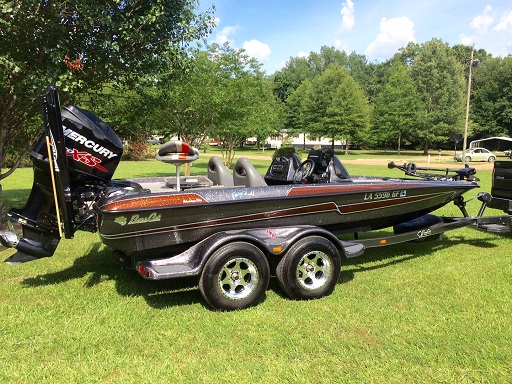
Great article. An in depth look at each model. I believe I would choose the Eyra. Down south I fish a lot of cypress trees..actually trolling between the trees and cypress knees. My 98 Jag does a great job. I figure the Eyra would be better. The wider boats have their good and bad. Personally I have a few buddys that have wide deck R models. It would be a struggle to follow me thru the stumps and trees I put the Jag thru. Too each his own. Again…very informative article!

If we ever move or build, Ill sell the Sabre & upgrade to a PIV. Its the model I want, just dont have the storage some for it here. The Sabre fits perfectly in the garage. And its a great boat. Just want a little more room.13 PIV w/ 200 MercIG: WarriorRiverCustomRods

That is a very well written and informative article

Very good read and very truthful. I too have had a bunch of co-anglers in my boat during a tournament and the first thing out of there mouth after the initial run in morning is…………”This SOB will run!”
I would have to stick to the Puma, as Im a long legged fella, and puma fits me perfect!! No bruised knees or shins

Never had a complaint either on ride or fishing from back. They are impressed when we blow by club members with 20-21 boats with 250s at blast off. Also they like how we stay on top of 2-3 chop for a smooth fast dry ride. BTW – there is a lot of deck room for the co-angler in the rear but if I have them run TM while I re-rig or something, a few have had issue on where the bow trim buttons are stepping on them by accident. I did that a lot too when I first got boat but you get used to it after awhile. Which reminds me I needed a new rubber cover for one I forgot to order when I placed my order a couple weeks ago. Damn.

Gotta go with the Eyra for my next boat. Been searching for used ones now for about a year but still none quite at my price yet. Next would be the cougar FTD.Jason Ferbrache – Edmond, OK 1995 Basscat Eyra

Great article!Ive been looking at BCB for a while now and trying to figure out the difference between the models and since we dont have any dealers close by with a good or any BCB selection to look at its been a little hard to pin point the model for me. Still wish you had a dealer near Cincinnati.
© 2026 Bass Cat Boats
