
Home › Forums › Bass Cat Boats › Battery placement in bilge
 oldtimer57.
Just have bought a new to me 2013 Pantera 2 with a SHO 200. Battery placement seem odd to me. The 2 trolling batteries are on the driver’s side and the cranking battery is on the passenger side. Doesn’t seem like the best way to balance. Boat chinewalks a lot. Seems to me the batteries need to be reversed (2 trolling batteries on port side, crank battery on starboard) to better balance weight. Has anyone else seen this? Thoughts welcomed….

Chine walk is not a balance issue, though seat time and learning how to drive. Do a search on the FAQ section and you will see two or three good articles on how to drive a high performance boat. Take your time and don’t overtrim.
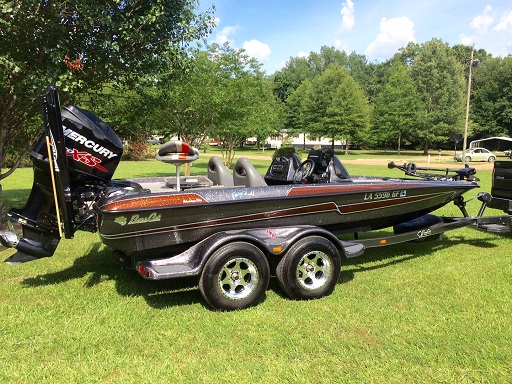
My PII is the same with Battery placement. Even if the batteries were positioned opposite drivers weight alone would put the weight on starboard side. Controlling chine is about drivers input. Even the fuel moving side to side when on pad (side winds hitting the boat) will change the balance of the boat and must be corrected by the driver.
As BCB stated, take your time and don’t over trim. If this is your first time in a performance hull make sure and read the link I provided.
Whatever you do, don’t chop the throttle when the chine starts. Just trim down till it stops.
Once you learn to drive the hull to its potential, you will see what owning a BCB is all about.
Congrats on a fine rig!
chine-walk-learning-to-control-it-my-ex … ml#p257841
I’ve had a few boats that chine walked and have been able to drive through the chine walk in them. My last boat was a Sabre FTD (2010 model) I bought new and could get every mph out of it. Batteries were placed with 2 trollers on port side, cranking battery on starboard side. In the article link in your post, read the section ‘Loading the boat’. To me it seems balancing the weight will help the boat overcome the rotation pull of the prop to push the boat off of the pad. In my Triton, I even put my heavy stuff in the compartment behind the passenger seat, leaving the one behind the driver’s seat open for coanglers, to balance weight some. In the article you have posted, it says he even went as far to use the gas from the starboard tank first to balance weight. I just thought it was odd the batteries were placed this way. I just had never seen the batteries placed this way, and thought changing it might help balance it on pad better.
This won’t help balance when under power. The steps up from a 150, or 175, to a 200 are pretty significant power ups and just take time. You can not drive through chine walk, you learn to control it. The only way you drive through it is by a poor performing setup and the engine being too high, in which the excess torque allows you to manage the hull. In that case it is loosing efficiency.
First thing I did when I brought home my new 2015 P2 was reverse those batteries, and, mount my single Talon on the port side as well. However, I fish alone most of the time, so I wanted to balance the boat best for that situation. As far as chine, seat time will be the only answer. The P2 is a little rocket, especially out of the hole.

Two points here.
left-right balance is definitely important. But getting it perfect won’t stop chine walk. Just will make it a little easier to control.
The big elephant in the room is that outboard hanging off the back. It is doing several things, all of which contribute to chine-walking. First, the prop is rotating in direct contact with the water. And as Isaac Newton pointed out, “for every action, there is an equal and opposite reaction…” So when that prop turns in one direction, the boat has to try to lean in the opposite direction. That twisting effect varies based on throttle position, trim position, sea state, etc. IE a dynamically changing set of circumstances. Additionally as the prop bites the water, it tries to act like a wheel on the road, which is turning 90 degrees to the direction of travel. That tries to pull the rear end in that direction (since the prop is not completely under water this force is only applied in one direction). Again, this force varies based on prop slip, skipping across waves, current, power setting, trim setting, engine height.
So. No matter what you do, you have to control chine walking with steering input. You can’t tune it out of the boat. You might tune it out for one specific set of circumstances, but as soon as one of the parameters change, walking starts.
There are lots of things that make chine walking worse. Most common one is slop in the steering so the motor can flop back and forth even when you hold the steering wheel solidly. Others are sloppy motor mounts, air in steering, loose bolts attaching steering, weak hoses, etc. Some say their boat doesn’t walk. If it runs 70, it will. Just remove your hands from the wheel and hang on. I would say mine doesn’t walk, because I have driven it so much I don’t think about what it needs to prevent walking. Sort of like riding a bike. You don’t think about all those front wheel movements when you are riding very slowly, you just do them as needed.
Getting the boat set up properly will always help, but you will always need to drive the thing once you reach the upper 60’s and beyond. Boat is balanced on a narrow platform at high speeds and it is not going to stay balanced for long with all the outside influences that act on the hull.
© 2026 Bass Cat Boats
